Steriods and Peptides Evolution
The Science of Hormones and Muscle Growth: How Anabolic Steroids Work at the Cellular Level
Jun
Buy Research Peptides Online, Understanding how anabolic-androgenic steroids (AAS) work requires a journey into the microscopic world of cellular biology. While the visible results—increased muscle mass and strength—are well known, the mechanisms behind these changes are a fascinating interplay of chemistry, genetics, and physiology.
This post breaks down the science into clear steps, explaining how these synthetic hormones travel through the body, enter muscle cells, and fundamentally alter how your DNA functions to build more muscle. Buy Research Peptides Online
What Are Anabolic-Androgenic Steroids?
First, let’s clarify the terminology. Testosterone, the primary male sex hormone, is itself an anabolic steroid. “Anabolic” literally means to build up tissue, referring to its ability to promote muscle growth, while “androgenic” refers to the development of male sexual characteristics.Buy Research Peptides Online
Synthetic anabolic steroids are chemically modified versions of testosterone. These modifications aim to achieve one or more goals:
- Increase the anabolic (muscle-building) effects relative to androgenic effects
- Improve oral bioavailability by resisting breakdown in the liver
- Prolong the duration of action in the body
It’s important to note that despite these modifications, no synthetic steroid has achieved a complete separation of anabolic and androgenic effects—which is why they are formally called anabolic-androgenic steroids (AAS).
The Journey: From Administration to Target Cells
How AAS Enter the Bloodstream
AAS can be administered in two primary ways:
Intramuscular Injection: Oil-based formulations create a “depot” in the muscle tissue. The AAS gradually diffuse out of this depot and into the bloodstream. The release rate depends on the chemical group attached to the parent molecule—longer ester chains (like enanthate) prolong the half-life from minutes to days.
Oral Ingestion: Orally ingested AAS are rapidly absorbed in the gastrointestinal tract but face a major obstacle: the liver’s first-pass metabolism. This can destroy a large fraction of the drug. To address this, chemists use 17α-alkylation—adding a chemical group that makes the molecule harder for the liver to break down, increasing oral bioavailability but also increasing the risk of liver damage. Buy Research Peptides Online
Transport Through the Bloodstream
Once in circulation, AAS travel bound to carrier proteins like sex hormone-binding globulin (SHBG) and albumin. Under normal conditions, only a small fraction (1-4%) of testosterone circulates “free” or unbound.
However, when AAS are used at supraphysiological (very high) doses, the binding capacity of SHBG is saturated. This means a larger fraction of the drug remains free, making it biologically active and able to reach its targets. Furthermore, many synthetic AAS have very low affinity for SHBG, meaning they are primarily carried by albumin and are readily available to exert their effects.
Crossing Cell Membranes
To affect a muscle cell, the steroid must cross two barriers: the capillary membrane and the muscle cell membrane.
- The capillary has small pores (fenestrae) that allow the steroid to pass easily.
- The muscle cell membrane, however, is a lipid (fat) bilayer. Because anabolic steroids are highly lipophilic (fat-loving), they can diffuse directly through this hydrophobic interior—a process called passive diffusion, which requires no energy.
The Mechanism of Action: How AAS Build Muscle
Once inside the muscle cell, the science gets even more interesting.
Step 1: Binding to the Androgen Receptor
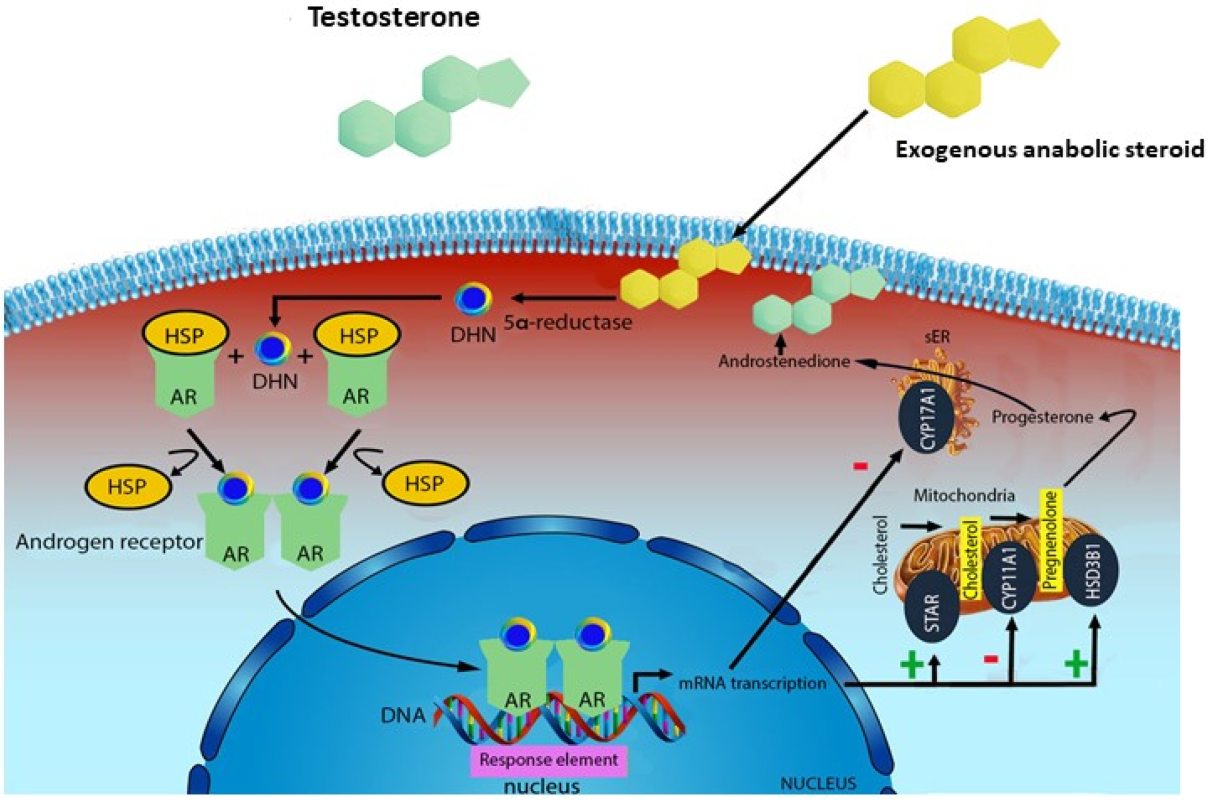
Inside the cytoplasm of the cell, the AAS molecule binds to a specific protein called the androgen receptor (AR) . This binding is the key that initiates the entire process of muscle growth.
Step 2: Entering the Nucleus and Altering Gene Expression
The AAS-receptor complex then moves into the nucleus of the cell—the part that contains the DNA. Inside the nucleus, this complex binds to specific regulatory sites on the DNA called androgen response elements (AREs) .
This binding is the molecular trigger for gene transcription—the process of “reading” the DNA to create messenger RNA (mRNA). The mRNA then travels out of the nucleus to the ribosomes, where it directs the synthesis of specific proteins.
In the case of AAS, the genes that are “turned on” are those that promote muscle growth. The result is an increase in the production of key structural proteins, particularly myosin and other myofibrillar proteins, which make up the muscle fiber itself.
Step 3: The Signaling Cascade (IGF-1/PI3K/Akt/mTOR Pathway)
The androgen receptor doesn’t work in isolation. It also interacts with other critical pathways that regulate muscle growth. One of the most important is the IGF-1/IGF-1R-PI3K/Akt-mTOR pathway.
Here’s a simplified version of how it works:
- AAS binding to the AR promotes the expression of insulin-like growth factor-1 (IGF-1) .
- IGF-1 binds to its receptor, which activates a cascade of signaling proteins, including PI3K and Akt.
- One of Akt’s key targets is mTOR (mammalian target of rapamycin) , a master regulator of protein synthesis.
- Activation of mTOR leads to increased translation of mRNA into new proteins, directly contributing to muscle fiber hypertrophy (growth).
This signaling cascade is a classic pathway for muscle hypertrophy and highlights the complex, multi-layered nature of how AAS work.
Beyond the Nucleus: Genomic vs. Non-Genomic Effects
The process described above—binding to a nuclear receptor and altering gene expression—is called the genomic pathway. It takes time, as it involves the step-by-step process of transcription and translation.
However, AAS also exert non-genomic effects. These are rapid actions that occur at the cell membrane, independent of gene transcription. They involve the activation of other receptors (like EGFR and SHBGR) and second messengers, leading to rapid increases in intracellular calcium (Ca²⁺) and other signaling molecules that can influence muscle function and contraction.
Key Takeaways: What This Science Means
- AAS directly alter your DNA: By binding to the androgen receptor, they change which genes are expressed, forcing the muscle to build more structural proteins.
- The AR is the key: Without the androgen receptor, AAS cannot exert their primary muscle-building effects. Research in rats shows that blocking the AR with drugs like flutamide prevents training-induced muscle hypertrophy.
- Multiple pathways are involved: The effects go beyond just the AR—AAS also activate powerful signaling cascades like the IGF-1/PI3K/Akt/mTOR pathway, which is a central driver of protein synthesis.
- The “androgenic” side effects are hard to avoid: The inability to completely separate anabolic from androgenic effects is why side effects like acne, body hair growth, and voice deepening occur, even with synthetic steroids.
This deep understanding of the science reveals why AAS are so effective at building muscle, but also why they carry such significant risks. The very pathways that drive muscle growth also impact other tissues, leading to the wide range of side effects we’ll explore in future articles.
